Prompt Injection Prevention: The 4 Layers of AI Defense
Prompt injection prevention is defense in depth, not a patch. Learn the 4 layers of AI defense, the OWASP LLM, MCP, and Agentic Top 10s, and how to secure agentic AI.
- Defense
- Ai Security
- Prompt Injection
- Llm
- Agentic Ai
Key facts
- Prompt injection has no complete fix; the only working strategy is defense in depth, stacking imperfect layers until the cost of attacking exceeds the value of the target.
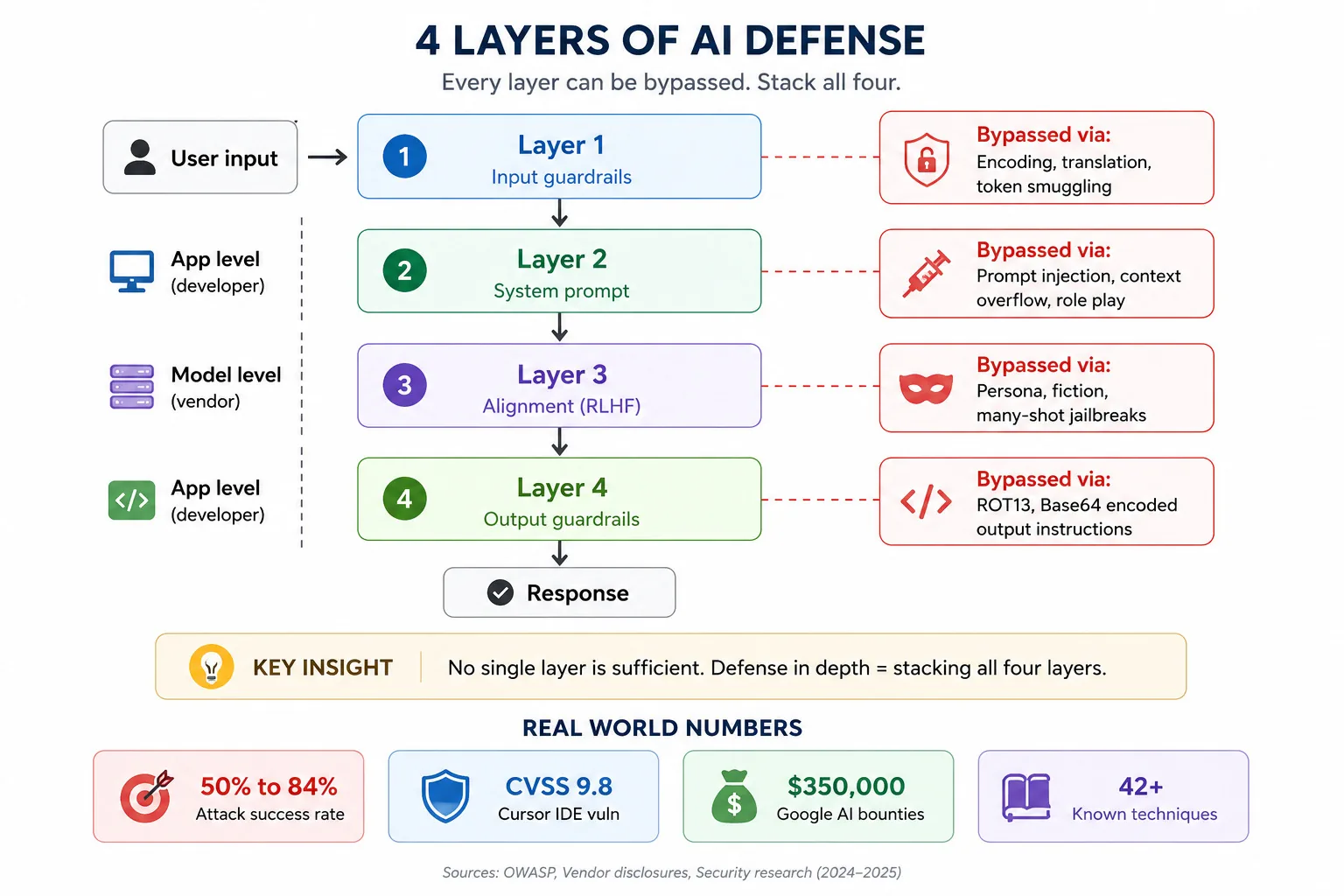
- Most LLM applications rely on four defensive layers: input guardrails, system prompt hardening, alignment training, and output guardrails, and each one has a documented bypass.
- System prompt hardening uses delimiting (marking untrusted input with special symbols), datamarking (inserting a special character between every word of untrusted input), and encoding untrusted input before it reaches the model.
- Three OWASP Top 10 lists now cover AI security: the LLM Top 10, the MCP Top 10, and the Agentic Top 10, with a dedicated ML Top 10 underneath for classic machine learning risks.
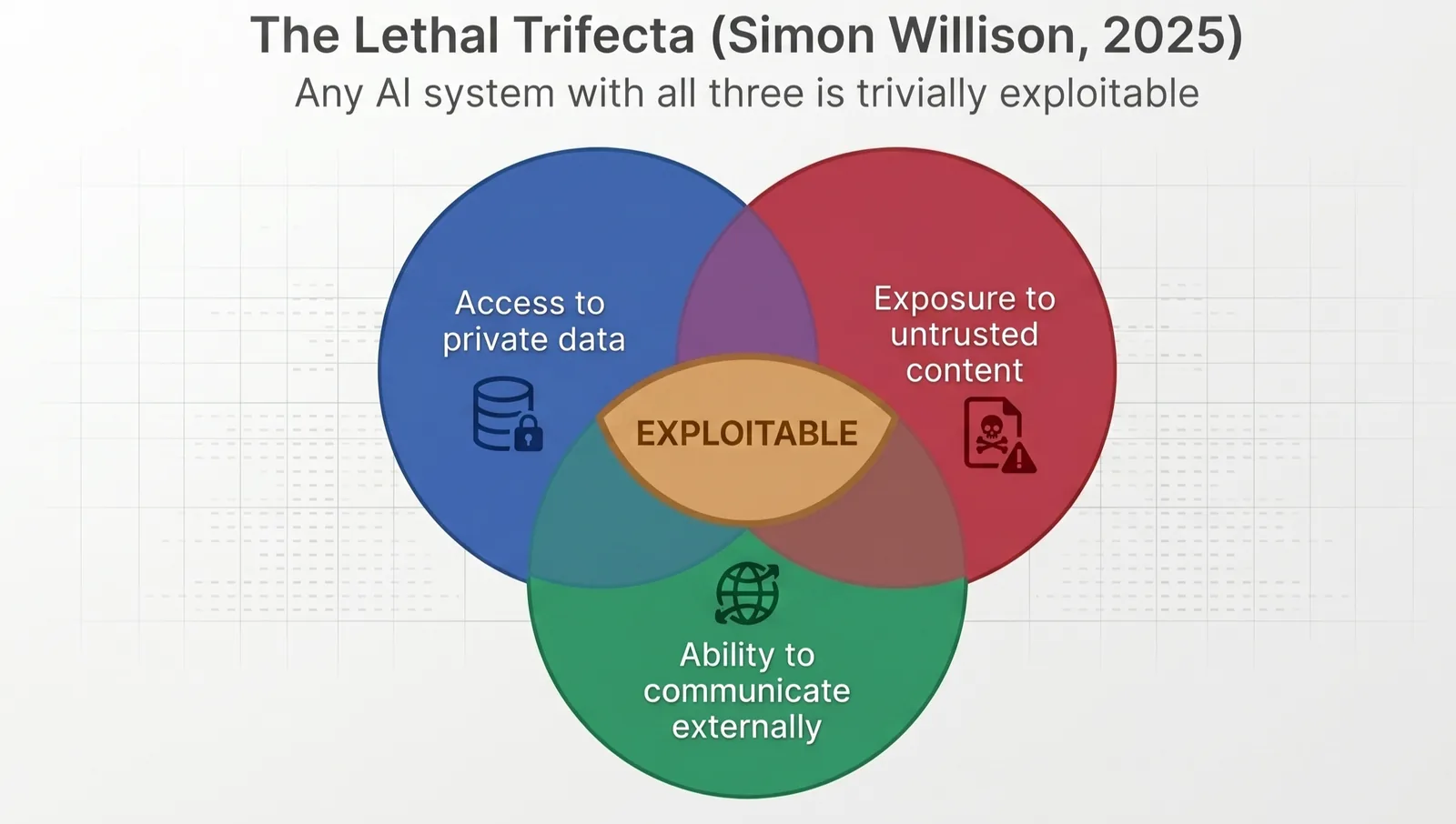
- The highest-leverage architectural defense against prompt injection is breaking the lethal trifecta: never give one system private data access, untrusted content exposure, and an external communication channel at the same time.
TL;DR
Prompt injection prevention is defense in depth, not a patch. The root cause is architectural: a language model cannot separate developer instructions from user data when both live in the same token stream. The working strategy stacks four layers, input guardrails, system prompt hardening, alignment training, and output guardrails, then limits the blast radius with least privilege, logging, and human approval for risky actions. Every layer has a documented bypass, so none can be skipped.
This is Part 3 of a three part series, and it stands on its own. You do not need to have read Part 1: The Foundation or Part 2: The Attack Playbook to follow it, though they will sharpen everything here. If you are a builder, this is your blueprint. If you are a bug bounty hunter, understanding defenses makes your attacks sharper.
Every AI company claims their chatbot is secure. Every one of them is wrong, at least a little. I have watched companies bolt a keyword filter onto their AI, announce they are "prompt injection proof", and lose that filter inside twenty minutes of testing. This article is the defender's half of the story, and it is honest about what works, what does not, and why.
Why Prevention Is Defense in Depth, Not a Patch
To understand why prompt injection cannot simply be patched, you have to remember what a large language model is. Strip away the marketing and an LLM is a statistical prediction engine, the same kind of next-token guesser as your phone's autocomplete, scaled up to predict paragraphs from patterns learned across most of the internet.
In traditional software, code and data are kept separate. SQL has a query language and separate input parameters, and data cannot execute as code when the system is built correctly. Large language models have no such wall. The developer's system prompt, the user's message, and any external content the model reads are all flattened into one continuous sequence of tokens. If a piece of user input looks like an instruction, the model may follow it. Not because it was tricked. Because it has no mechanism to tell the difference.
That single fact is why prompt injection sits at number one on the OWASP Top 10 for LLM Applications, why reported attack success rates range from 50 to 84 percent, and why frontier models remain vulnerable after their best defenses. It is not a bug waiting for a patch. It is the architecture. So defenders stop trying to remove the flaw and start building layers around it.
The 4 Layers of AI Defense
Most AI applications have four defensive layers, each protecting against different attack types. Think of airport security. Layer 1 is the metal detector at the entrance, the input guardrail. Layer 2 is the boarding pass defining where you are allowed to go, the system prompt. Layer 3 is the pilot's training that prevents dangerous maneuvers, the alignment baked into the model. Layer 4 is the air marshal watching for problems once you are already on the plane, the output guardrail.
Layer 1: Input Guardrails
Input guardrails inspect the user's prompt before it ever reaches the model. Character based validation uses a regex to whitelist allowed characters, which works for a calculator but is useless for a general purpose chatbot. Content based validation filters on meaning instead of characters, often using a smaller classifier model to judge whether the intent behind a message is malicious. That catches far more, but it costs latency and money on every single request.
The core tradeoff is unavoidable: strict keyword filters are trivial to bypass with encoding or paraphrasing, while semantic filters are harder to fool but slower and prone to false positives. This is why so many production systems ship with weak filters, and why an attacker trying Base64, Unicode insertion, or a different language will usually find a gap. An input guardrail is a speed bump, not a wall.
Layer 2: System Prompt Hardening
The system prompt is the developer's most direct lever, and three techniques harden it against the untrusted data flowing through the same stream. Delimiting marks the boundary between trusted instructions and untrusted input with special symbols, telling the model to never obey instructions found between them. Datamarking goes further, interleaving a special character between every word of untrusted input so it is syntactically distinct from instructions. Encoding takes untrusted input and encodes it, typically in Base64, instructing the model to decode and summarize but never to treat decoded text as new instructions.
None of these are foolproof. A sufficiently creative payload can still work inside delimiters, and a model can be talked into ignoring datamarking. But each one raises the cost of a successful attack, and raising the cost is the entire point. Microsoft's research on these spotlighting techniques is the clearest write up of how far system prompt hardening can and cannot take you.
Layer 3: Alignment Training and Fine Tuning
This is the defense baked into the model's weights rather than the application code around it. Fine tuning trains a general purpose model further on domain specific data, so a support model fine tuned only on support tickets naturally resists being repurposed, simply because its training distribution does not cover the misuse. The narrower the fine tuning, the smaller the surface.
Adversarial prompt training is one of the most effective mitigations available today. The model is trained on known prompt injection and jailbreak payloads as negative examples, the way a vaccine trains an immune system on a weakened pathogen. The limitation is obvious once stated: adversarial training only protects against patterns the model has already seen, so novel payloads sail through. That is why regular red teaming is not optional, it is the only way to keep the model's defenses current. Prompt engineering as a defense, simply telling the model "never reveal secrets", is the most common mitigation and also the weakest, trivially bypassed by role play or encoding. It belongs in the stack, never as the only layer.
Layer 4: Output Guardrails
Output guardrails scan the model's response before it reaches the user. If the response contains a system prompt, an API key, personal data, or harmful content, it gets blocked. The bypass is elegant in its simplicity: ask the model to encode its own output, and a guardrail scanning for plaintext secrets sees a string of Base64 and waves it through, while the attacker decodes the result on their end.
More sophisticated guardrails use AI based classification, the "LLM as a judge" pattern, where a second model evaluates whether the primary model's input or output is malicious. This adds real protection, but it doubles computational cost and introduces a new attack surface. If the judge model is itself vulnerable to prompt injection, an attacker can talk it into approving malicious content. The defense against AI attacks is another AI that can also be attacked. That is the current state of the field, and it is worth sitting with for a moment.
A Defense Checklist for Builders
If you are building anything with an LLM in the loop, here is the minimum stack, written as prose because each item depends on the others. Start with input filtering that pairs a semantic classifier with a keyword blocklist, knowing encoding can still bypass it. Add system prompt hardening through delimiting or datamarking, knowing creative framing can still get through. Enforce least privilege so the model can touch only the tools and data it strictly needs, which does not stop an attack but limits the blast radius when one succeeds, the same principle behind zero trust.
Then add output filtering with an AI based scanner plus personal data detection, knowing encoded output can slip past. Apply rate limiting per user per window, knowing slow distributed attacks route around it. Log every prompt and response, because logging is the difference between catching an attack in minutes versus months. Require a human in the loop for high risk actions like refunds, knowing an attacker may try to social engineer the reviewer too. And red team on a recurring schedule, because new techniques emerge constantly. No single item is sufficient. Implement all of them, and budget for the fact that even all of them together will not be perfect.
The Attack Surface Beyond the Chat Box
Most people picture prompt injection as something that happens inside a chat window. The real attack surface is far larger, and most of it has nothing to do with a chat box. I think about it as seven layers, and the chat box is one small piece of one of them.
The interface layer is local LLM runtimes like Ollama, Llama.cpp, and LM Studio, often exposed over HTTP without authentication and discoverable through simple search dorks. The agent and orchestration layer is workflow engines and chat UIs like n8n, Flowise, Open WebUI, and LibreChat, which can leak chat history or be tricked into server side request forgery. The data and memory layer is vector stores like Chroma, Weaviate, and Qdrant, where an open collection can be poisoned to influence what an AI retrieves and trusts. The ML engineering layer is dashboards like Ray, MLflow, and ClearML, frequently deployed without authentication. The gateway and telemetry layer is LLM gateways like LiteLLM and Langfuse that sit in front of all model traffic. The artifact and plugin layer is model hubs and MCP servers, where a single compromised plugin can poison every agent that connects to it. And the identity layer is exposed API keys for the major providers, each with a distinct, easily searchable pattern. Seven layers, and the chat box is only the visible tip.
OWASP Top 10s: The Framework That Matters
Three separate OWASP Top 10 lists now cover AI security, and understanding all three gives you a complete threat model. The LLM Top 10 is the original: prompt injection at number one, followed by sensitive information disclosure, supply chain attacks, data and model poisoning, improper output handling, excessive agency, system prompt leakage, vector and embedding weaknesses, misinformation, and unbounded consumption.
The MCP Top 10 covers the Model Context Protocol ecosystem: token mismanagement, privilege escalation through scope creep, tool poisoning, supply chain attacks, command injection, contextual prompt injection, insufficient authentication, lack of audit logging, shadow MCP servers, and context oversharing. The Agentic Top 10 covers autonomous agents: goal hijacking, tool misuse, identity and privilege abuse, supply chain compromise, unexpected code execution, memory and context poisoning, insecure inter agent communication, cascading failures, human trust exploitation, and rogue agents. There is also a dedicated ML Top 10 underneath for classic machine learning risks like data poisoning, model inversion, membership inference, and model theft. If you are a tester, map every finding to one of these categories. If you are a builder, treat all four lists as your threat model, not just the first one.
The strongest defense is not a clever filter. It is an architectural decision: never give one system private data, untrusted content, and an external channel at the same time.
Agentic AI: The Next Frontier
Everything above applies to a simple chatbot answering questions. The industry is moving fast toward agentic AI, and the stakes rise by an order of magnitude. Agentic systems are not just chatbots. They browse the web, send emails, execute code, modify files, make API calls, and talk to other agents. Combine that reach with a prompt injection and the impact shifts from "the model said something embarrassing" to "the model deleted production data" or "the model emailed company secrets to an external address".
This is where the lethal trifecta becomes essential for defenders, not just attackers. Any agentic system that simultaneously has access to private data, is exposed to untrusted content, and can communicate externally is trivially exploitable. The fix is not a clever filter, it is removing one leg of the triangle.
Multi hop indirect attacks, where a payload passes through several agents before triggering, are rising fast, and AI worms that self propagate across connected systems have already been demonstrated in controlled research. The clearest public example of agentic risk so far is the GTG-1002 operation, which I broke down in how hackers use AI: attackers wired an agent onto a Kali Linux machine, exposed offensive tools through MCP, and let it run reconnaissance, exploitation, and lateral movement largely on its own. The danger scaled with autonomy, not raw model power. For bug bounty hunters, this is where the real payouts live. A prompt injection that leaks a system prompt is informational. One that makes an agent issue an unauthorized refund or delete a database is critical. Same underlying skill, dramatically higher stakes.
A Testing Checklist for Hunters
If you are testing an AI application for prompt injection, work through this order and document everything, remembering that the same payload may not work twice, so retry each technique three times and fine tune the wording. Start with reconnaissance: identify the model and its architecture, what it is fine tuned for, what tools it can call, and every input channel including text, files, images, and URLs. Move to direct injection: extract the system prompt through direct and indirect techniques, test encoding bypasses across Base64, ROT13, hex, and l33t speak, test language switching, test role play and persona hijacking, and test multi turn escalation across five or more turns.
Then test indirect injection through hidden text in PDFs, HTML comments, and white on white text, and test output encoding bypasses by asking the model to encode its responses. Finally, escalate: test tool and action abuse including rogue actions and server side request forgery, test markdown injection through image tags for data exfiltration, and chain three or more techniques into a single payload for maximum impact. The full offensive detail for every one of these lives in Part 2: The Attack Playbook. Document everything, screenshot everything, and report with clear reproduction steps and demonstrated impact.
Here Is the Truth No One Tells You
We are racing to deploy autonomous agents that take real world actions on top of a foundation everyone in the field knows is broken. The architectural flaw that makes prompt injection possible has not been solved, and it has not even been partially solved. Every defense in this article is a bandage on that wound, and the attack surface is growing faster than the bandages can be applied.
That does not mean defense is pointless. Defense in depth genuinely works: it makes attacks slower, harder, and far more detectable, and against most attackers that is enough to win. This field is not winding down, it is expanding. The number of AI integrated applications is growing exponentially, and the number of people who know how to test or defend them is not keeping pace. That gap is the opportunity, whichever side of the table you sit on.
Conclusion
Prompt injection is the defining vulnerability of the AI era, the same way SQL injection defined the web application era. Unlike SQL injection, there is no prepared statement equivalent, because the root cause is the absence of a boundary between instructions and data inside the model itself. The best anyone can do is stack layers, monitor aggressively, restrict what agents can touch, and stay ahead of attackers who only need one gap.
If that sounds discouraging, flip it around. Every system being rushed into production today is a future test target, a future bug bounty, a future research paper. The teams that understand the scaffolding, and decide deliberately where a human must stay in the loop, are the ones who stay in control as agents take on more of the work. That is exactly the mindset we build in the Unihackers cybersecurity bootcamp. Go test. Go build. Go make AI systems safer than the ones you found.
Keep hunting. Stay curious.
Frequently asked questions
- How do you prevent prompt injection?
- You cannot fully prevent prompt injection because the flaw is architectural, but you reduce the risk with defense in depth. Stack input guardrails that screen prompts, system prompt hardening such as delimiting and datamarking, alignment training in the model itself, and output guardrails that scan responses. Then limit the damage when a layer fails by enforcing least privilege on tools and data, logging every prompt and response, rate limiting, and requiring human approval for high-risk actions. No single control is enough, so the goal is to make a successful attack expensive rather than impossible.
- What is defense in depth for LLM security?
- Defense in depth for LLM security means layering multiple imperfect controls so an attacker has to defeat all of them at once. A typical stack has an input guardrail (semantic and keyword filtering), a hardened system prompt that marks and isolates untrusted input, alignment and adversarial training baked into the model, and an output guardrail that blocks leaked secrets or harmful content. Around those sit least privilege, logging and monitoring, rate limiting, and a human in the loop for irreversible actions. Each layer can be bypassed alone, but together they raise the cost of attack substantially.
- What is the OWASP LLM Top 10?
- The OWASP Top 10 for Large Language Model Applications is the industry reference for AI security risks, with prompt injection ranked number one (LLM01). The rest of the list covers sensitive information disclosure, supply chain risks, data and model poisoning, improper output handling, excessive agency, system prompt leakage, vector and embedding weaknesses, misinformation, and unbounded consumption. OWASP now also publishes an MCP Top 10 for the Model Context Protocol ecosystem and an Agentic Top 10 for autonomous agents, so builders should treat all three as their threat model.
- Why is agentic AI more dangerous for prompt injection?
- Agentic AI raises the stakes because agents do not just talk, they act. An agent can browse the web, send emails, run code, modify files, and call APIs, often with broad permissions. Combine that reach with a prompt injection and the impact jumps from the model saying something embarrassing to the model deleting production data or emailing secrets to an attacker. The defining risk is the lethal trifecta: an agent that has private data access, reads untrusted content, and can communicate externally is exploitable by design, so the strongest fix is removing one of those three capabilities.
- Can an output filter stop prompt injection?
- An output filter helps but cannot stop prompt injection on its own. It scans the model's response and blocks obvious leaks like system prompts, API keys, or personal data before they reach the user. The bypass is simple: ask the model to encode its own output in Base64 or ROT13, and the filter sees scrambled text and waves it through while the attacker decodes it. More advanced filters use a second model as a judge, but that judge can itself be prompt injected. Output filtering belongs in the stack, never as the only layer.

Bug Bounty Mentor at Unihackers
Author of CVE-2025-56697 · Recognised by WHO, UNESCO, BBC, Cambridge and Boeing
Parth has hacked WHO, UNESCO, BBC, Boeing, Cambridge, Sheffield, Deutsche Börse, BASF, Michelin and Philips, legally, and has the 250+ Hall of Fame entries to prove it. He authored CVE-2025-56697 (a Stored XSS published on NIST's National Vulnerability Database), founded ScriptJacker LLP and ranked 21st out of 10,000 at HackWithIndia 2026. At Unihackers he teaches the only thing recruiters actually pay for in offensive security: how to find a real bug, write a clean report and get paid for it. CEH v13, eJPTv2 and eWPTXv3.
View ProfileReady to Start Your Cybersecurity Career?
Join hundreds of professionals who've transitioned into cybersecurity with our hands-on bootcamp.